As I mentioned in last weeks On the Wing, I'm revamping the OUT blog by posting on here once a week. I've recently gotten an internship that allows me unlimited time outside and the ability to teach others about the environment, the natural world, and the creatures that inhabit it. However, due to not getting enough sleep last night, I am instead inside writing the first entry I've put up here in a while.
Over the past week, my roommate and I have been tasked with looking for "signs of spring" that signal the end of winter and the beginning of the slow transition from the cold, dark times to the happy, warm times. This isn't to suggest one can't have fun in the winter, but to be honest after the snow we had up north, I'm ready for the buds and blooms of spring.
Today was rainy. As such, I had to go out to do a journaling activity which involved log rolling and invertebrate investigation. It was great! Despite the puddles of water and torrents of rain soaking me from head to foot (although my Carhartt kept me nice and warm throughout), I noted several types of invertebrates, as well as, rubs on the trees from last years deer rut and saw a flock of White-throated Sparrows (Zonotrichia albicollis) and Dark-eyed Juncos (Junco hyemalis) mingling together in the wooded tangles. As I traversed back, I managed to flush an American Woodcock that was roosting in a nearby thicket (Scolopax minor) and could hear the incessant peeping cries of Spring Peepers (Pseudacris crucifer) in the wet areas near the meadows. It was an entertaining walk and I look forward to our hike to another part of the property tomorrow.
Less friendly signs of a warm up were also apparent as I found my first Deer Tick (Ixodes scapularis) crawling on my back today. Looks like bug spray will be a necessity from now on. Despite this little pest, much of my trips have been joyous exercises of nature observation and enjoyment. I've been fiddling with a new camera and have been putting most of the photos on my Flickr account and I've been keeping a bird list of what I've see on the property (38 so far and it isn't even migration season yet!) Most of all, I'm pleased I've found an internship that fits me so well and will hopefully provide me with the path I want to follow in life. Have a great week y'all and I'll see you over at On the Wing!
I'm back! After getting an internship so closely tied to the environment and nature itself, I figured it was time to take OUT for a spin once again. As such, I'll be blogging once a week about a topic that's held my attention for much of the week or possibly even something completely random. Anything naturey could be discussed from critters to weather to plants and fungi, environmental issues, land practices, and much much more.
Tuesday, March 12, 2013
OUT!! #20: Signs of Spring
Labels:
I'm back,
internship,
nature,
observations,
OUT blog,
spring
Sunday, January 27, 2013
OUT!! #19: Final Entry
This has been an interesting adventure, but it's time to move on. I'll continue to update my other blog at On the Wing: A Life Inspired by Birds with the regular two week updates. Thank you for all the page views and I hope I have been a good writer enough to warrant such attention. Have a good day.
Wednesday, December 12, 2012
OUT!! Disclaimer/Walk Back
With the recent job search I'm conducting as well as the demands of my current work/lifestyle and the needs of the sister blog, I'll be updating here less. Don't worry though. I'll update this once a month starting next year owing to the title of the blog. I just thought I'd make that clear before you guys thought I'd vanished. The need to do two entries for On the Wing takes time and because I'm running the Babe Ruth of Ornithology tournie right now, that eats up some time too. Just some clarification. Merry Christmas and a Happy New Year!
OUT!! #18: Wild Suburbanites and the Domestication of Humankind
Suburbia is the greatest threat to wildlife in regards to habitat loss, shrinking wild spaces, and increasing tensions between the humans that want to live in an area and the wild animals that already do. Or is it?
After taking a walk with a family friend of mine to Earthplace, a nature discovery museum and conservancy in Westport, Connecticut, we looked up to see a White-tailed Deer (Odocoileus virginianus) bounding across one of the nearby lawns and later walk calmly over to the backyard of one of the neighboring houses. This is hardly surprising after all. As of the year 2000, there was estimated to be over 76,000 deer in the whole of Connecticut with the highest densities in areas with high residential populations, mixed growth forests, and reduced predator populations. This isn't surprising considering that the line between suitable wildlife habitat and resources have been blurred ever since people have lived side by side with wild places.
I remember sitting in my room late one night earlier this fall and had the windows open to have some air flow. The neighbourhood pup was barking up a storm when suddenly it went quiet. I furrowed my brow. "Finally." I thought to myself. The thing barked most nights and it was nice to have some quiet. Instead it was replaced with a different sound. "Yip-yip-kayoooooo!" The howl was followed by a cackle of answering howls and whoops. "Coyotes." I thought to myself. "I've never heard them so close to the house." I listened for a while more as they transitioned through the neighbourhood and faded into the dark of the night. Having such wild creatures so close to our homes, lives, and experiences makes me so glad. It means that regardless of what structures and changes man makes to the environment, animals can adapt (some better than others, but for the sake of the argument I'll continue with what I'm saying) to these new areas and still flourish despite these changes.
Not everyone agrees however. Recently a story in the New York Times caught my attention (see link here) that made me both angry, yet sympathetic. What annoyed me about the article initially was the title. The use of the word "guardian" in relation to the wolves that were being hunted seemed to immediately polarize the audience into those supporting the hunting of the wolves involved and those who think wolves are the symbol of wilderness in need of love and understanding and never to be threatened by the barbarism of hunters who are only doing what's legal under the current laws within that state. As you can probably guess, I'm more sympathetic to the hunters on this one. I do this primarily because anytime a story about hunting hits papers on both coasts, animal rights folks take to the airwaves announcing the cruelties and injustices that these "barbaric" humans do to these creatures.
While I'll let you read the rest of the article, I have come to some conclusions about this whole issue. While this post started out nicely enough, this particular issue has been bugging me for some time. The general gist of the whole issue centers around appropriate use of resources and what our role on the Earth is. I've come to reason that humans with our advances in technology, medicine, architecture etc. have effectively bred ourselves out of the standard problems facing most organisms on this planet. For the most part we have become quite domesticated with cozy houses, plentiful foodstuffs, and the ability to travel easily where ever, when ever. Even those that spend more time outside and possess even a modest set of survival skills can at best be called feral. We're no longer the wild creatures that once fled from the plains to escape Short-faced Bears (Arctodus spp.) and Sabertooth Cats (Smilodon spp.), but instead get worried when gnats and spiders invade our homes. While its certainly a good time to be alive in the more built up areas of the world, I have to say that we're ill-prepared when it comes to disaster. As aftermath of the recent hurricane that devastated parts of New Jersey and New York has come to pass, I waited to hear stories of hope, but also of the ever present news of people who thought that the storm wouldn't be that bad and decided to hide in their houses and apartment blocks. Some had no choice while some knew better, but they stayed nonetheless. There was tragedy, loss of property and lives. People mourn and while I'm saddened by the loss, I know that had they not gambled in the presence of Mother Nature's wrath, they might still be alive today.
I've always marveled at people who return to the place of a coastal natural disaster. The neighbourhood ripped to shreds by wind and water, the soil mixing with sand and destabilizing the roads, and random debris causing chaos throughout. The strength it must take to rebuild your house once, twice, three more times when a blow comes through and levels everything. I still don't know how people in the Midwest deal with tornadoes all summer! What I suppose I'm trying to get at is that people seem to have misplaced priorities when it comes to where it's a good place to live. Next to the beach is cool until it floods during a storm or gets washed away by a hurricane. In the woods is fine until people start complaining about their animal neighbours because they weren't aware that it was their home before they built a luxury cabin nearby. Even in the cities with animals like coyotes (Canis latrans), deer, Red-tailed Hawks (Buteo jamaicensis), and others coming in from shrinking habitats and are finding homes in our yards and gardens, there are some who welcome them, while most are scared of the wild creatures that seem to be stealing ground back from the humans who took it from them. We all have our place in this world, but I think its time we prioritize on what and where ours is. Is it in dominion over the creatures of the Earth or is it in a sustainable manner that allows us to experience those wild lives, but still have ourselves to count on as well. Just a thought.
Labels:
conflicts,
domestication,
humans,
land use,
storms,
what is our place in this natural world,
wildlife
Friday, November 30, 2012
OUT!! #17: Nature I Loved
There's always a certain quality to outdoor life stories that have us drawn in again and again and again. Not survival stories necessarily, but a good "I'm going to the woods to find out who I am" sort of story. "Nature I Loved" by Bill Geagan is just such a story. The blurb on the back of the book describes the basic plot as the following: "Badgered by his parents to settle down, find a good job, and get married, Geagan spent two years alone thinking things over. He found good solutions. Full of hunting and fishing scenes, young and old alike will identify with this heartwarming true story."
The real sticking point for me was that, as a lover of the outdoors and of Mother Nature herself, I've always been intrigued by the prospect of an outdoor life by doing a combination of self sufficient living and woodsman skills. But I always felt I fell short, either in regard to basic survival skills to the remoteness that Geagan experienced back in those days and even whether I could even undertake such a seemingly monumental task. I remember picking this book up as a freshman at Unity College and reading it cover to cover. The journey Geagan was taking seemed so distant from what my path seemed to be at the time: a college aged boy learning the skills and concepts he would need to get a job in the wildlife management field and then go on to live his life according to that plan. However recently, as I spend my days sitting and reading and thinking (my current job has a lot of down time), I've come to relate to some of the themes brought about by the author. I can relate to the sense of hopelessness one feels when they cannot find something they like or want to do as well as the societal expectations one feels pressured upon them when they can't get a job quickly enough or even one associated with their degree of study. I feel fortunate though that during the period Geagan lived in, I don't have to live under the same conditions. Having been published in the 50s, the idea of settling down with a good job and a family on the way seemed like the perfect model for life at the time. Thank goodness he took a different path. (Mind you he got "there" eventually, but by no means in a conventional manner.)
I love stories like this with their rich descriptions of nature and its wonders, but also the hard reality of the situation he put himself in so he could find his true passion in life. As I was reading over it today, I read a paragraph that reassured a position I'd held for a while, but never had the courage to hold aloft as my own. No worries though. It's not a major character issue or problem, but instead the idea of beauty vs. function when it comes to fishing flies. I'm the type of person that will use something over and over again because it works as opposed to what it looks like. This is why I prefer using hand-tied nymph flies over dries. This is primarily because dries are supposed to imitate a specific surface insect form while a nymph can be bushy, pulled loose, and wooly without the fish paying too much mind to it. It's also because I tie really crappy dry flies. What's most important however, is the motion given to the fly or lure that will attract the fishes attention, rather than size, shape, or bold and bright colors. Geagan writes of an angler he met in his first summer while chopping wood at his cabin and describes the flies the man was using as "…very large, very gaudy, and very heavily dressed wet flies tied on huge hooks that somebody had unloaded on him." While it is true that some of the most complex salmon flies ever tied are beautiful pieces of art (as seen below), as Geagan describes, they are woefully overdressed for most situations.
Geagan said it best on pg. 158 when he described how they were more often human attraction devices than fish catching ones.
The real sticking point for me was that, as a lover of the outdoors and of Mother Nature herself, I've always been intrigued by the prospect of an outdoor life by doing a combination of self sufficient living and woodsman skills. But I always felt I fell short, either in regard to basic survival skills to the remoteness that Geagan experienced back in those days and even whether I could even undertake such a seemingly monumental task. I remember picking this book up as a freshman at Unity College and reading it cover to cover. The journey Geagan was taking seemed so distant from what my path seemed to be at the time: a college aged boy learning the skills and concepts he would need to get a job in the wildlife management field and then go on to live his life according to that plan. However recently, as I spend my days sitting and reading and thinking (my current job has a lot of down time), I've come to relate to some of the themes brought about by the author. I can relate to the sense of hopelessness one feels when they cannot find something they like or want to do as well as the societal expectations one feels pressured upon them when they can't get a job quickly enough or even one associated with their degree of study. I feel fortunate though that during the period Geagan lived in, I don't have to live under the same conditions. Having been published in the 50s, the idea of settling down with a good job and a family on the way seemed like the perfect model for life at the time. Thank goodness he took a different path. (Mind you he got "there" eventually, but by no means in a conventional manner.)
I love stories like this with their rich descriptions of nature and its wonders, but also the hard reality of the situation he put himself in so he could find his true passion in life. As I was reading over it today, I read a paragraph that reassured a position I'd held for a while, but never had the courage to hold aloft as my own. No worries though. It's not a major character issue or problem, but instead the idea of beauty vs. function when it comes to fishing flies. I'm the type of person that will use something over and over again because it works as opposed to what it looks like. This is why I prefer using hand-tied nymph flies over dries. This is primarily because dries are supposed to imitate a specific surface insect form while a nymph can be bushy, pulled loose, and wooly without the fish paying too much mind to it. It's also because I tie really crappy dry flies. What's most important however, is the motion given to the fly or lure that will attract the fishes attention, rather than size, shape, or bold and bright colors. Geagan writes of an angler he met in his first summer while chopping wood at his cabin and describes the flies the man was using as "…very large, very gaudy, and very heavily dressed wet flies tied on huge hooks that somebody had unloaded on him." While it is true that some of the most complex salmon flies ever tied are beautiful pieces of art (as seen below), as Geagan describes, they are woefully overdressed for most situations.
| The Green Highlander. More appropriately designed to capture the attention of humans than of trout. |
"With the white hair from the tail of the deer, also squirrel hair, feathers from the hens, and what materials I had in my kit, I was able to turn out a large number of streamers, also wet flies and tiny dry flies. My flies were far from first class. They would never have sold in the stores. But they weren't tied for fisherman, they were tied for fish and they caught them and stood up well under the punishment. Most flies I have seen in the shops were tied to attract the fisherman. And they buy them at prices I have always thought were much too high. The flies are gaudy and usually too heavily dressed to fool fish, particularly those wise old guys on waters that are fished hard."I'm always amazed by the simplicity presented in this book, how function generally trumps form and how a little ingenuity and thinking can yield much better results than just sticking to convention. That's ultimately what brings me back to the book over and over again. Having some different idea or concept from everyone else and trying to work it out another way rather than hopelessly grinding away at tried and worn out trails to the same future trodden on by the feet of so many others. It's exactly what Thoreau described when he explained that "most men lead lives of quiet desperation…" We all want avoid that trap, so I give you the advice of another one of America's greats, Mark Twain.
"Twenty years from now you will be more disappointed by the things that you didn't do than by the ones you did do. So throw off the bowlines. Sail away from the safe harbor. Catch the trade winds in your sails. Explore. Dream. Discover."Thank you for reading and have a lovely weekend.
Labels:
bill geagan,
fishing,
fly-tying,
form vs. function,
life's goals,
making one's own way,
nature I loved
Thursday, November 15, 2012
OUT!! #16: Mallards are Whores!
I was going to supplement the attention-seeking title above with more appropriate photos, but the ones I took today are gone. Why you ask? My ƒ%&$ing computer decided to delete not only the photos I took today, but also iPhoto crashed during final upload meaning that all the wonderful photos I took for my other sites are gone. GONE! Siiiigh, damn you technology.
Back to the subject at hand, I do have pictures of a similar hybrid/manky birds that will suit the purposes of this post well enough. Hopefully, I can make my point just as well with them.
The reason for the provocative title is because as any waterfowl biologist, birder, and aviculturists will tell you, Mallards (Anas platyrhynchos) are adulterous rapists. You heard me right. As shocking as this may seem, it is easy to write off the Mallard as a species is a diverse mishmash of colors, sizes, distributions, and origins. It's even been considered a complex much like the many circumpolar gull species that are present in the northern hemisphere, but I digress. Due to it's almost international distribution and presence on any available water body, it can live pretty much anywhere where there's food, shelter, and of course, water.
However, this presents problems for two species unique to North America, the American Black Duck (A. rubripes) and Mottled Duck (A. fulvigula). While similar in appearance the Black Duck is named for its dark body plumage, while the Mottled Duck lives up to its name by the male and female of the species possessing mottled plumage. As with the Mallard, the sexes can be separated by bill color with males possessing yellow-green bills and females sporting orange bills with brown blotches. The main problem for these birds is that they're similarly colored to female mallards and through no fault of their own often end up producing hybrid young. Whether or not this is due to being previously related to mallards in the past is to be decided in a later post (see end of this post)


As explained in the initial paragraph, I saw several "manky" birds today (to steal a phrase from here) that seemed to either be fertile hybrids or inbred with feral waterfowl. But due to a technological glitch and iPhoto system failure on my end, I don't have any of those photos any more. (I'll save the weeping for later ;_; ) However, below I've included some pictures from my Florida trip earlier this year as well as some other photos of the "Mallard complex". See if you can spot the weird ones.
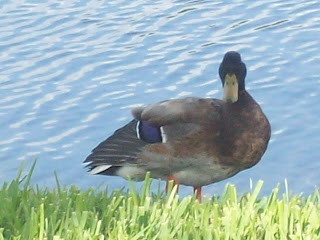
Did you guess correctly? If not, you can clearly see that the fourth and fifth pictures clearly show a rufous-looking male Mallard with more extensive chestnut on his breast and belly than a normal gray-bodied male. Since I can't be sure of its origins, I can only speculate that it's more likely to be a feral cross than a wild bird cross. As for what can be done about it, that "Mallard complex" I was talking about earlier might be to blame. I'd go on to explain further, but due to the lateness at the time of writing this, I'm inclined to stop. Here however is another example of the fine complexities that Mallards display with some of the problems mentioned here.
For the final post this month, I might explore this subject a bit more by explaining my take on the "Mallard complex". I do this because of my interest in waterfowl in general, but also because I have an interest in the kind of results hybridization can have on separate species and populations. Hopefully I can explain it with better descriptions and pictures than I was able to do here. Until then, I hope you all have a lovely weekend outside in the wild blue yonder.
Update: It would appear that my computer saved the pictures of the manky mallards I wanted to post on here in the first place. Therefore, I'm going to include those pictures in this post to show what I was trying to illustrate before I supposedly lost everything. I will reiterate my point when I write more thoroughly about species complexes next week for the final posting of the month. I need to remember that this blog is for all things wildlife and associated with wildlife problems, people, and events so by focusing on a whole big taxonomic thing, I end up doing more of a service that way. Also if I want to rant about birds whenever, I'll just do so on the birding blog here. Now that that's out of the way, I'll leave you to appreciate the pictures I still had even if iPhoto seemed to crash and lose them all.
It was these three specifically show a dark bodied male Mallard but plumage details such as lack of a neck ring, overall dark body color, and lack of a defined breast color might point to a manky bird or fertile hybrid.
All I can say for sure is that while they add diversity to the field in terms of what one can see in the colors of the species, in the end, it just makes it a hell of a lot more confusing.
Back to the subject at hand, I do have pictures of a similar hybrid/manky birds that will suit the purposes of this post well enough. Hopefully, I can make my point just as well with them.
The reason for the provocative title is because as any waterfowl biologist, birder, and aviculturists will tell you, Mallards (Anas platyrhynchos) are adulterous rapists. You heard me right. As shocking as this may seem, it is easy to write off the Mallard as a species is a diverse mishmash of colors, sizes, distributions, and origins. It's even been considered a complex much like the many circumpolar gull species that are present in the northern hemisphere, but I digress. Due to it's almost international distribution and presence on any available water body, it can live pretty much anywhere where there's food, shelter, and of course, water.
However, this presents problems for two species unique to North America, the American Black Duck (A. rubripes) and Mottled Duck (A. fulvigula). While similar in appearance the Black Duck is named for its dark body plumage, while the Mottled Duck lives up to its name by the male and female of the species possessing mottled plumage. As with the Mallard, the sexes can be separated by bill color with males possessing yellow-green bills and females sporting orange bills with brown blotches. The main problem for these birds is that they're similarly colored to female mallards and through no fault of their own often end up producing hybrid young. Whether or not this is due to being previously related to mallards in the past is to be decided in a later post (see end of this post)
As explained in the initial paragraph, I saw several "manky" birds today (to steal a phrase from here) that seemed to either be fertile hybrids or inbred with feral waterfowl. But due to a technological glitch and iPhoto system failure on my end, I don't have any of those photos any more. (I'll save the weeping for later ;_; ) However, below I've included some pictures from my Florida trip earlier this year as well as some other photos of the "Mallard complex". See if you can spot the weird ones.
Did you guess correctly? If not, you can clearly see that the fourth and fifth pictures clearly show a rufous-looking male Mallard with more extensive chestnut on his breast and belly than a normal gray-bodied male. Since I can't be sure of its origins, I can only speculate that it's more likely to be a feral cross than a wild bird cross. As for what can be done about it, that "Mallard complex" I was talking about earlier might be to blame. I'd go on to explain further, but due to the lateness at the time of writing this, I'm inclined to stop. Here however is another example of the fine complexities that Mallards display with some of the problems mentioned here.
For the final post this month, I might explore this subject a bit more by explaining my take on the "Mallard complex". I do this because of my interest in waterfowl in general, but also because I have an interest in the kind of results hybridization can have on separate species and populations. Hopefully I can explain it with better descriptions and pictures than I was able to do here. Until then, I hope you all have a lovely weekend outside in the wild blue yonder.
Update: It would appear that my computer saved the pictures of the manky mallards I wanted to post on here in the first place. Therefore, I'm going to include those pictures in this post to show what I was trying to illustrate before I supposedly lost everything. I will reiterate my point when I write more thoroughly about species complexes next week for the final posting of the month. I need to remember that this blog is for all things wildlife and associated with wildlife problems, people, and events so by focusing on a whole big taxonomic thing, I end up doing more of a service that way. Also if I want to rant about birds whenever, I'll just do so on the birding blog here. Now that that's out of the way, I'll leave you to appreciate the pictures I still had even if iPhoto seemed to crash and lose them all.
It was these three specifically show a dark bodied male Mallard but plumage details such as lack of a neck ring, overall dark body color, and lack of a defined breast color might point to a manky bird or fertile hybrid.
All I can say for sure is that while they add diversity to the field in terms of what one can see in the colors of the species, in the end, it just makes it a hell of a lot more confusing.
Labels:
American Black Duck,
complex,
computer troubles,
mallards,
manky birds,
mottled duck,
whores
Tuesday, November 6, 2012
OUT!! #15: Hunting Redux
This past week I finished an excellent book that illustrates the dilemma that I'm feeling at the moment. I'm keen to get into hunting both as an addition to my other outdoor activities such as canoeing, fishing, and birding and as a means to provide a natural form of protein in my diet, but finding ways to start is often daunting. From various hunting related articles and shows that I've seen I'm keen to experience nature in the closer forum that hunters engage in, but also to be a part of a natural process that we are increasingly becoming estranged from as time goes on.
"Call of the Mild: Learning to Hunt My Own Dinner" by Lynn Raff McCaulou is just the volume to help me with my small plight. Having gotten my hunters education squared away, finding opportunities to be able to go out and experience the hunter's point of view has proven to be my primary sticking point, as well as not having legal arms to pursue game with. (What about that bow you mentioned in OUT!! #1 you might suggest? Well that was sold for gas money so I'm in a bit of a hole at the moment.)
Ms. McCaulou's journey started after moving to Oregon for a change from the NYC urban life she was living as an assistant in the Indie film industry. She picked up a reporting job where she began to meet hunters who would talk about how much their sport means to them and how they care about the animals they seek for sport and food. This led McCaulou to look into her own views about the environment and how they fit in with a viewpoint consistent with the agenda the hunters put forward as well as her own beliefs about the environment we all share for recreation and resources alike. This doesn't mean however that she accepted hunting outright after hearing a few good stories from local hunters. She did what anyone would do if shifting to something that is different from ones prior experiences and goes through a process that includes her assumptions about herself, her confidence to pull through on her goal to hunt, and her belief that she had the strength of will and spirit to be able to pursue this blossoming dream of hers. What she wrestles with most is the idea of taking the life of an animal. She references Bambi as a point in her childhood where she makes the connection that the reason hunters hunt is because they hate their prey and want to destroy them. As she thought about what taking the life of an animal means to her, questions like "Is it justified?" and "Will the guilt drag me down?" feature prominently throughout the book and her thought process. She eventually learns to manage the guilt by coupling it with the idea that by selecting one animal to be killed for food, it allows others to survive and perpetuate the species for future hunters to enjoy.
As her confidence grows, she finds that she is reclaiming or even resuming a once forgotten place in the natural world as a creature surviving on the meat of a fellow creature. She also recognizes her role as a hunter ensures money is provided to conservation efforts to purchase habitat for game and non-game alike, as well as, providing funding for research and monitoring on wildlife populations on both state, federal, and where applicable, private lands. As I finished the book, it reiterated a theme that I feel not only in my own life, but have seen elsewhere as well. The more technology one surrounds themselves with, the further they are from the heart of this world. We can hide ourselves from the soil and leaves and trees and animals, but we are still part of this big, wide world that we call home. We can claim human privilege and uniqueness, but ultimately we are organisms that need food, shelter, water, and sunlight for survival, but these are but basics. If we are to survive, we need to focus on the planet and how our needs reflect sustainable use of those resources we need to survive.
Personally, I see hunting as a method as surviving in a world that's plagued by meat of questionable origin and treatment before killing for our consumption. It also helps to know where ones food comes from and through that virtue, being able to provide that essential food for oneself and others who desire it. After watching several episodes of Fieldsports Britain on YouTube, I've become enamored with air guns and their simplicity, as well as effective use to dispatch a variety of pest and small game species. I want to start off slowly, with smaller prey that will allow me to hone my skills towards something larger or quicker, like ducks, or turkey, or deer. Hopefully, I can get myself on the next step towards hunting proficiency and be able to effectively take game safely and fairly. After reading this account about a fellow "adult on-set hunter", I can only hope for the best and learn the skills that will help me assume the mantle of an ethical, but effective hunter.
Labels:
call of the mild,
environment,
hunting,
Lynn Raff McCaulou,
new experiences,
starting point,
transition
Subscribe to:
Posts (Atom)