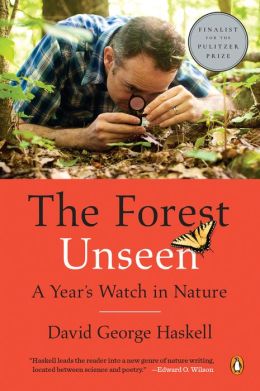
 A forest is a forest is a forest right? Well that would be an extremely short sighted view of the amazing variety and changes that took place in Shakerag Hollow in Sewanee, Tennessee as it was watched over by David George Haskell. The book starts simply with a common teaching technique used by teacher naturalists called a spot sit. He elaborates upon it by relating it back to a sand mandala that was created at the university where he works and how it represents elements of change, beauty, interconnectedness, and impermanence. As the mandala is brushed up and is sprinkled bit by bit, to flow away along a stream, he brings us back to the section of forest that he is to keep vigil over for the year.
His quiet observations show the changes of the seasons as plants and animals prepare for the warmth of spring, the bounty of summer, the simmering fall, and the eventual quiet grip of winter. While his writing is a little difficult to grasp to begin with, his style of mixing scientific inquiry and observation with poetic musings about the environment around him proves to be an interesting blend. While the chapter headings direct the reader towards his subject matter, he is by no means specifically bound towards just that one subject. Playing off of the importance of interconnecting players within this ecological space, he illuminates his readers on the relationships of parasitism displayed by the tachnid fly and the horsehair worm, the perceived sexual deviancy of snails, the energy consumed by chickadees if seeds are eaten instead of insects, and how the ugliness of a golf ball isn't necessarily the ultimate polluting sin. Indeed, what many outdoor observers seem to miss is how interconnected the world is and how if one thing is altered, the balance of a whole ecosystem is dislodged.
I feel that his spot sit is something anyone can try even if it seems a little difficult at first. People these days have trouble sitting still, even for long periods. This seems counter intuitive because of all the jobs that involve sitting at computers these days. It's hard, especially for my generation, who wants things to be interactive and instantaneous and I can't imagine what it's going to be like for the up and coming generations as tech gets faster and more invasive. But you should really give it a try. Pick a spot where people are unlikely to disturb you and just sit. It's that easy. Some might be intimidated by all that's going on around them, but I urge you to at least try. If you do so with some regularity you'll see changes taking place. You might notice the changes in the plants first, before animals become accustomed to your presence. Take your time. If you make it your goal to learn everything about everything, you'll get frustrated quickly. Observe first and if you have any questions, note them down. Observe, then query. It's not only the most scientific way of learning, but it also leaves more room for paying attention to what's going on around you.
If there are any people in your life with an interest in nature or are naturalists themselves, I highly recommend this volume. Once a month, I'll be reviewing a book that centers on natural themes such as nature observation, outdoor exploration, or a general appreciation for the natural world. I hope I can share what I'm reading with people and in turn, people can inform me of what they like as well.
Have a lovely rest of your weekend.


